The Invisible Divide: Why AI Workflow Automation is the New Literacy
The underlying trend shifting the knowledge economy from using software to orchestrating outcomes—and what it means for your career.


In this article
The era of being highly skilled at clicking buttons inside a specific SaaS tool is ending.
For the past decade, career success in the knowledge economy was usually determined by software specialization. If you knew how to navigate the complex, labyrinthine menus of Salesforce, set up custom dashboards in HubSpot, or write advanced formulas in Excel, you had job security. You were the "software admin," the gatekeeper of a specific tool, translating human needs into software actions.
But this gatekeeper role is rapidly depreciating.
We're now entering a period where software is no longer a collection of siloed destinations that require human tour guides. Instead, software has become very fluid. We're now moving from managing individual tools to orchestrating automated systems.
This is not just another tech trend or a minor upgrade in software efficiency. It's a fundamental restructuring of what constitutes valuable work. An invisible divide is forming in the workforce: on one side are those who execute manual tasks inside software, and on the other are those who design the automated systems that execute those tasks. In this new landscape, AI workflow automation is not just a utility—it's now the new literacy.
The Underlying Trend: The Hollowing Out of "Glue Work"
To understand why this shift is happening so quickly, we have to look at the convergence of two technologies: APIs and Large Language Models (LLMs).
Historically, software integration was rigid. APIs allowed application A to talk to application B, but only if the data was perfectly structured and the rules were pre-defined. If you wanted to send a lead from a web form to your CRM, an API could map "First Name" to "First Name."
But if application A sent a messy, unstructured transcript of a sales call, traditional APIs couldn't extract the key action items and log them into the correct fields in CRM. That task required a human. Humans served as the "cognitive glue," manually reading, summarizing, interpreting, and copy-pasting data between tabs.

LLMs have completely hollowed out this cognitive glue work. Because LLMs can process unstructured data, reason through instructions, and output structured JSON, they can now act as the decision-making middle layer inside API calls.
When you combine the reasoning ability of an LLM with the execution capability of an API, you get autonomous workflow automation. You no longer need a human to read an email, decide if it’s a support request or a sales lead, summarize the problem, look up the customer's history in a database, and write a draft response. An AI-powered workflow can execute the entire sequence in seconds, leaving only the final review to a human.
As a result, the value of knowledge work is shifting. The market no longer rewards the execution of routine digital tasks. It rewards the architecture of the systems that run them.
The Bifurcation of the Knowledge Worker
This macro trend is creating a stark bifurcation in the professional landscape, dividing knowledge workers into two distinct classes:
Type A: The Manual Operator (The Replaced)
These are workers whose primary value is executing repetitive processes. They spend their days copy-pasting data, writing standardized email responses, manually updating status fields in project management boards, or synthesizing reports from spreadsheets.
Because their work lacks high-leverage decision-making, it is highly vulnerable. In an era of automated workflows, paying a full-time salary for manual data movement is no longer economically viable for businesses.
Type B: The Systems Orchestrator (The Unreplaceable)
These are operators who do not just use software—they build systems. They understand the business logic of a process, map out the data flow, and connect APIs and LLMs to run the loop automatically.
A Systems Orchestrator might not know how to write Python, but they know how to configure a webhook, structure a prompt to output valid JSON, and handle API rate limits. They focus on designing, auditing, and optimizing the machine, rather than being a cog inside it.
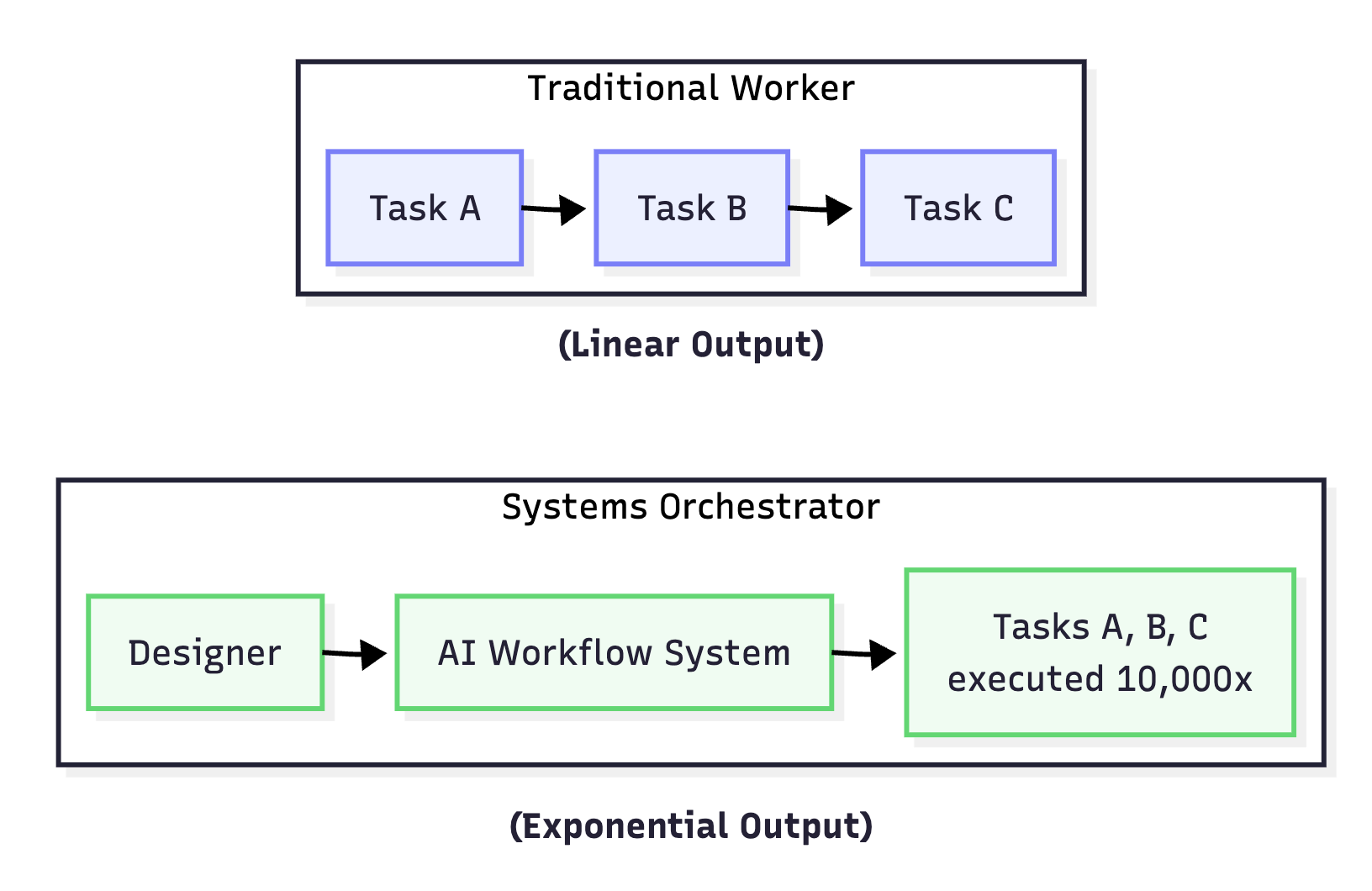
The difference in leverage between these two classes is compounding. While a manual operator’s output is capped by the number of hours they work, a Systems Orchestrator's output is limited only by their ability to design robust systems. A single orchestrator can manage workflows that do the work of an entire traditional department.
This shift has made systems thinking the single most important skill for career longevity. Understanding how to structure data, handle conditional logic, and guide LLMs to make deterministic decisions is the modern equivalent of knowing how to write. If you cannot automate your own job, someone else will build a workflow that does.
The Business Reality: Compounding Leverage
For businesses, the transition to AI workflow automation is not about replacing humans; it is about survival. Organizations that run on automated workflows operate with significantly lower overhead, higher speed, and fewer errors than those relying on manual labor.
Consider a common operational task: Lead Enrichment and Outreach.
In a traditional sales setup, an SDR manually searches LinkedIn, copies company data, finds email addresses using a browser extension, drafts a personalized message based on the company's recent news, logs everything in a CRM, and sends the email.
Let's look at the raw numbers when comparing this manual approach to an automated workflow using Make.com, Clay, and an LLM:
| Operational Metric | Traditional Method (Human SDR) | AI Workflow Automation (Make.com + Clay + LLM) |
|---|---|---|
| Time per Lead | ~15 minutes | ~12 seconds |
| Monthly Volume Capability | ~500 leads | 5,000+ leads |
| Error Rate | High (Fatigue, data entry typos) | Near Zero (Standardized parsing logic) |
| Monthly Cost | ~$4,000 (SDR Salary + tool seat licenses) | ~$150 (API credits + automation platform) |
| Speed to Lead Outreach | Hours or Days | Under 2 minutes from trigger event |
The automated stack does not just reduce costs; it fundamentally changes the capability of the business. It allows a small 3-person agency to run outbound campaigns at a volume and personalization level that previously required a 15-person business development team.
This compounding leverage is why VC-backed startups and lean bootstrapped operations alike are prioritizing automation-first architectures. They are realizing that hiring more people to solve operational bottlenecks is a legacy solution. The modern solution is to write a workflow.
The Pragmatic Playbook: Where to Start Today
Transitioning from a manual operator to a Systems Orchestrator does not require going back to school for a computer science degree. The no-code and low-code ecosystems have matured to the point where business logic, not syntax, is the primary constraint.
If you want to start building this literacy today, you can follow this simple playbook:
1. Document Your Daily Friction
Identify the task you do every day that makes you feel like a robot. If a task requires you to open more than three tabs, copy data from one place to another, or write the same email template with minor edits, it is a prime candidate for automation.
2. Standardize the Logic
Before you open an automation tool, map out the process on paper or a digital whiteboard. Write down the exact rules:
- What is the Trigger? (e.g., "A new row is added to this Google Sheet")
- What is the cognitive decision? (e.g., "Read the comment and classify it as positive, negative, or neutral")
- What is the Action? (e.g., "If negative, send a Slack alert to the support channel; if positive, send to the marketing channel")
3. Build a Simple Note-to-Task System
As a starter project, automate your meeting workflow. Here is a simple blueprint you can build in an afternoon:
- Trigger: A new audio recording is uploaded to a Google Drive folder (from your phone or Zoom).
- Action 1 (Transcription): Send the audio to Whisper API (via Make.com) to get a text transcript.
- Action 2 (AI Reasoning): Send the transcript to an LLM model (like Claude or GPT) with a prompt: "Identify the key decisions made and extract a list of action items with assignees. Output as a clean Markdown list."
- Action 3 (Distribution): Append the summary to a running meeting notes document in Notion, and automatically create tasks in Trello or Asana for each action item.
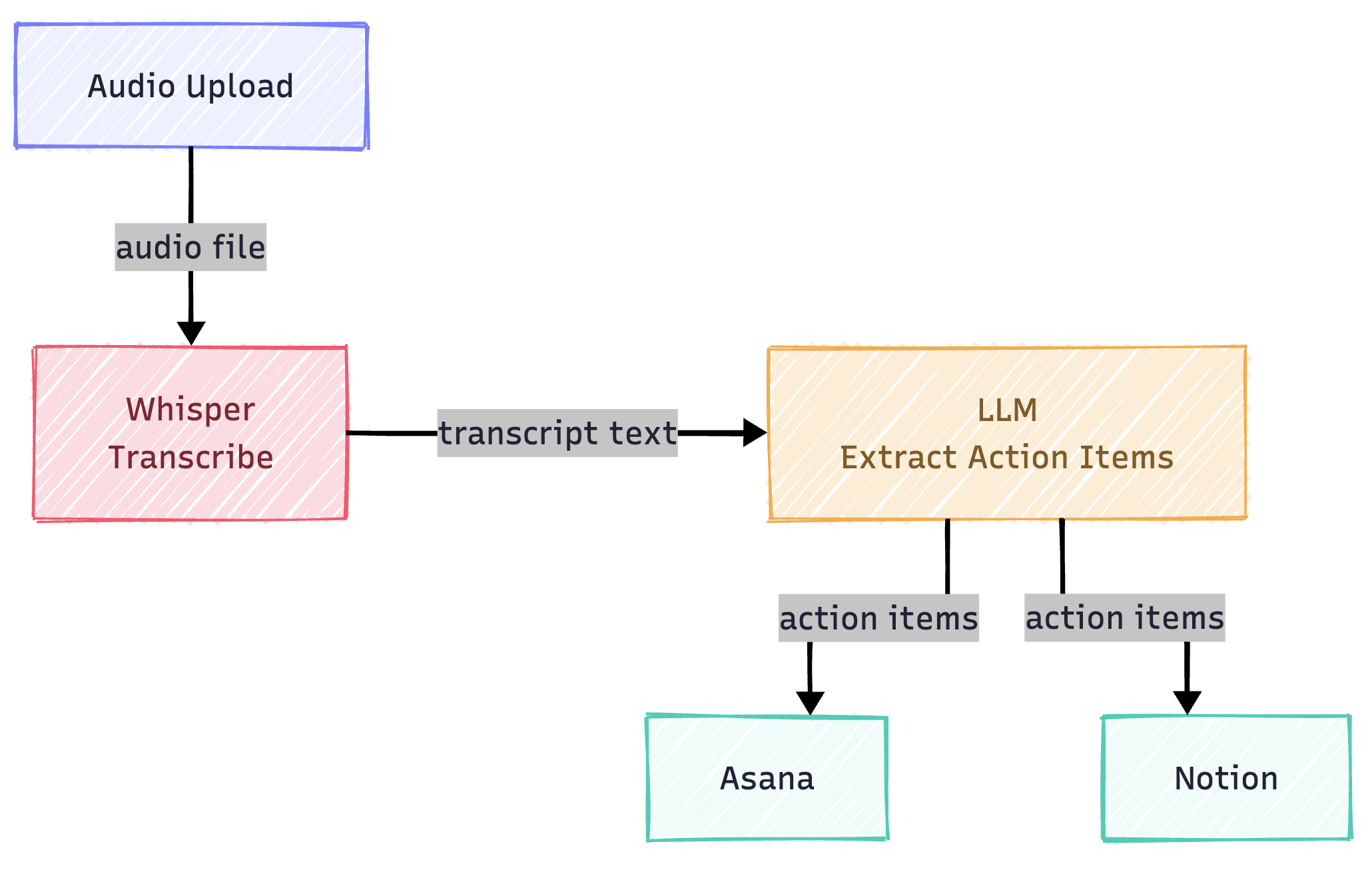
Once you build and run this workflow for the first time, your relationship with software changes permanently. You stop seeing tools as static storage units and start seeing them as nodes in an active, automated network.
Honest Caveats: The Invisible Cost of Automation
While the benefits are clear, it is irresponsible to pretend that automation is a magic wand with no downsides. As you transition to a systems-first approach, you must be prepared for the hidden costs:
1. The Maintenance Tax
Automations are inherently fragile. Because they rely on third-party APIs, webhooks, and software interfaces, they can and will break. A tool updates its API payload, an LLM prompt behaves unexpectedly after a model update, or a service goes down. As an orchestrator, you must budget time for debugging and maintaining your systems. If you automate 50 tasks, you are now the site reliability engineer for 50 micro-services.
2. The Context-Collapse Risk
When you automate communication, you risk stripping away the empathy and nuance that human operations provide. Sending an automated email based on a poorly interpreted AI classification can alienate a customer. Never automate irrevocable actions—like sending billing disputes, processing refunds, or publishing public content—without a human-in-the-loop review step.
3. The Automation Trap
It is incredibly easy to waste 10 hours automating a task that only takes 5 minutes to do manually once a month. Before you build, calculate your ROI. If a workflow doesn't save you at least 2 hours a week or eliminate a critical operational bottleneck, do it manually.
The Path Forward
The divide between those who use software and those who orchestrate it is widening every day.
The goal of learning AI workflow automation is not to turn yourself into a machine; it is to free yourself from working like one. By offloading the cognitive glue work to automated systems, you reclaim the time needed for strategic thinking, creative problem-solving, and deep human relationships—the exact skills that AI cannot replicate.
Mastering this new literacy is the single best investment you can make in your own professional leverage. Stop executing the process. Start building the machine.
Want to skip the trial-and-error of building these systems from scratch? Explore Workstak Runtime to have custom operational systems engineered for your business, or browse our free Resource Hub for deployable system prompts and workflow blueprints.
Prioritize Workstak on Google
Enjoyed this analysis? Add us as a preferred source in your Google settings to get our weekly software teardowns and reviews directly in your feed.
Found this guide valuable?
Share it with other operators and builders.
Keep reading
All postsIdea Engineering: How to Find and Vet Products Worth Building
In an era where AI makes execution trivial, the real skill isn't building fast—it's choosing the right problem to solve.
Demystifying Agent Skills: The Rise of the SKILL.md
Stop bloating your system prompts. Learn how modular skill directories make LLM agents actually reliable.
Don't miss the next one
Get execution intelligence delivered.
Operational playbooks, systems architecture, and grounded analysis — zero filler.